
Oliver Wolfs & Coach Vic
TL;DR
Sponsors don't leave because partnerships fail - they leave when clubs can't prove value. A structured 90-day renewal framework, real-time reporting dashboards, and purpose-built sponsorship tools can boost retention by 67% and deliver a 78% increase in partnership revenue.
Sports clubs often lose sponsors due to poor management, not poor partnerships. Sponsors expect clear proof of value, measurable ROI, and consistent updates. Without these, even successful collaborations can fall apart.
A structured 90-day renewal framework - focused on performance audits, tailored proposals, and timely communication - can boost retention by up to 67% and reduce costs compared to acquiring new sponsors.
“Sponsors don't renew based on goodwill; they renew when value is clear and future plans are aligned.”
The key to securing a sponsorship renewal lies in proving the partnership's value. Sponsors don't usually walk away because the collaboration failed - they leave when clubs can't demonstrate its success. Without hard data to back up the value delivered, sponsors may look to cut costs or explore other options. Even if the partnership provides real benefits, failing to document and communicate those results can make it seem less credible, especially to a sponsor's CFO.
Every dollar a sponsor spends must be justified. If a club can't show clear ROI - like audience engagement stats, evidence of asset delivery, or measurable business outcomes - the sponsor's internal team has little to present to their leadership. Without tangible metrics such as verification photos or engagement figures, even high-profile partnerships can lose their appeal.
“Sponsorship is no different from any other form of marketing expenditure - it requires clear and concise evaluation against its aims to justify its existence and ultimately its associated expenditure.”
Brand Finance
Relying solely on logo placements can make the partnership feel transactional, especially if on-field performance falters and visibility decreases. Solid evidence allows clubs to engage in strategic conversations during the renewal phase, shifting the focus to measurable business results rather than vague assurances.
Delays or gaps in reporting can create a measurement blind spot where important metrics go untracked. When recap reports arrive weeks late or lack critical engagement data, sponsors start to question the club's professionalism and ability to manage their investment effectively. Brands using integrated sponsorship software that tracks exposure, brand equity, and sales impact data report 20-30% higher renewal rates than those relying only on impression numbers.
Irregular communication can erode a sponsor's trust. If clubs only reach out when it's time to renew, sponsors may feel undervalued. Partnerships that include consistent mid-season check-ins are 31% more likely to secure renewals. Regular communication also helps clubs stay informed about changes in the sponsor's marketing priorities, allowing them to adjust activation plans as needed. If a sponsor's CMO requests performance updates and the club delays for a few days to gather the numbers, the damage is already done. The relationship remains transactional instead of developing into a strategic collaboration.
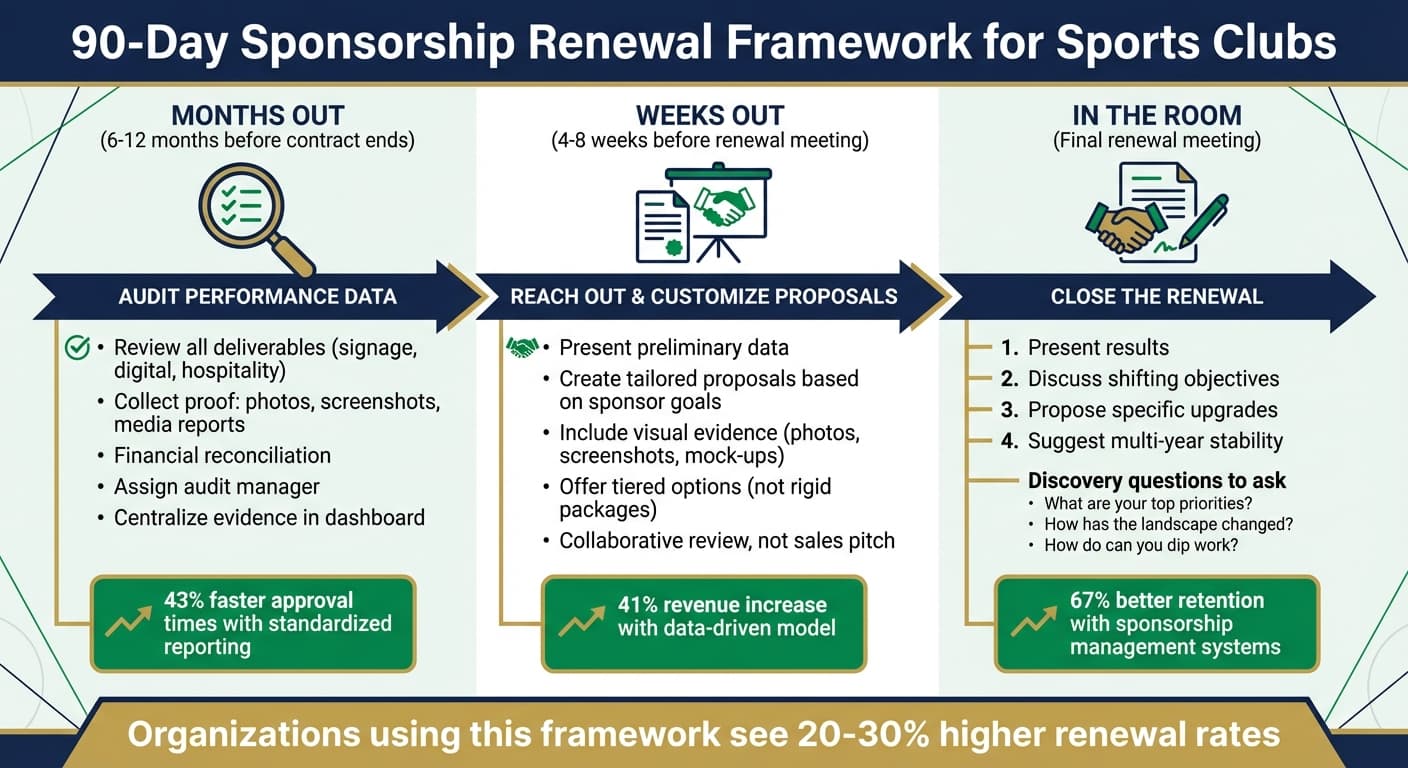
Many clubs make the mistake of waiting until the last minute to think about renewals. By then, it's often too late to fix issues or gather the evidence needed to make a strong case. A structured 90-day approach gives you the time to evaluate past performance, prepare thoroughly, and approach renewal discussions confidently - without the last-minute scramble.
Start your audit 6 to 12 months before the contract ends. Go through every deliverable in the agreement - whether it's signage, digital placements, or hospitality packages - and confirm that all obligations were met. Collect proof, such as photos, social media screenshots, media reports, and invoices. This documentation not only shows accountability but also strengthens your position during discussions.
Don't overlook financial reconciliation. Ensure the payments match the value delivered, and identify any gaps or make-good opportunities before the sponsor points them out. For instance, a national quick-service restaurant chain implemented a RACI model and standardized reporting templates in 2024, which sped up approval times by 43% and improved delivery compliance by 28%. To keep everything organized, assign one person to manage the audit and centralize all evidence in a dashboard.
Reach out to present preliminary data four to eight weeks before the renewal meeting. Scrambling to assemble reports at the last minute signals poor preparation. Use the performance insights you've gathered to create tailored proposals that reflect the sponsor's current goals. Include visual evidence like activation photos, social media screenshots, and asset mock-ups. Instead of rigid 'Gold, Silver, Bronze' packages, offer tiered options that can adjust to different budget levels.
Treat this phase as a collaborative review rather than a sales pitch. Discuss what worked, what didn't, and how the sponsor's priorities may have changed. Use this feedback to propose upgrades - such as new digital integrations, expanded hospitality options, or improved data tracking - that align with their evolving needs.
The final meeting should focus on strategy. Start by showcasing measurable wins and clear ROI. Follow a four-step structure: present results, discuss shifting objectives, propose specific upgrades, and suggest multi-year stability. Engage the sponsor with discovery questions like: What did your leadership value most? What areas fell short? What are your growth plans for the next year?
Build your presentation around a clear narrative: What did we do? What happened? What did we learn? What should we change? Organizations that use dedicated sponsorship management systems see 67% better retention rates compared to those relying on manual tools like spreadsheets and email. Having real-time dashboards at your fingertips allows you to address questions immediately, showing a level of preparedness and professionalism that sponsors appreciate just as much as the partnership itself.
Sponsors don't renew partnerships on goodwill alone. They need solid proof of value and a forward-focused strategy to justify their investment. To secure a renewal, it's essential to provide three key elements: measurable ROI, access to real-time performance metrics, and a clear plan for future collaboration.
Start by presenting the numbers. Sponsors want to see hard data that proves their investment paid off. Metrics like social shares, comments, click-through rates, and dwell time show how well the campaign engaged the audience - not just how many people saw it. Reinforce these stats with tangible evidence like timestamped photos, screenshots of digital posts, and delivery confirmations.
Attribution is another must. Tools like unique QR codes, promo codes, and dedicated landing pages can directly link sponsorship activities to measurable conversions. Nielsen reported that Bud Light's NFL sponsorship delivered a 4.3x ROI - meaning every dollar spent returned $4.30 in revenue. Brands using platforms that combine exposure data with sales impact often see renewal rates jump by 20% to 30% compared to those relying solely on impression numbers.
Sponsors don't want to wait for post-campaign reports. They expect real-time dashboards where they can monitor performance and fulfillment as it happens. Providing this level of transparency builds trust and eliminates any last-minute surprises when it's time to discuss renewal.
A regional CPG brand streamlined its CRM and task management into one platform, uncovering $200,000 in unfulfilled assets and cutting reporting time by 70%. When sponsors can log in and see their partnership's progress in real time, it reinforces confidence and strengthens the relationship. It's not just about reporting past success - it's about showing ongoing value.
Renewals aren't just about proving past success; they're about selling the future. Sponsors want to know how the partnership will evolve to meet their changing goals. Present customized activation ideas that align with their priorities, and use visuals to make these concepts easy to understand. Start discussing future plans well before the contract expires, proposing enhancements like digital integrations, expanded hospitality options, or better data tracking. When you show that you're committed to their future, sponsors are far more likely to re-sign.
Many clubs still rely on outdated, manual tools to manage sponsorships. Contracts often sit buried in email attachments, while fulfillment tracking is scattered across separate spreadsheets. This fragmented approach leads to one major issue: a lack of a reliable source of truth. When team members work from different versions of a spreadsheet, data becomes inconsistent. Worse, critical information can vanish when a key staff member leaves.
“Manual is Liability, Sponsorship Management Software is Leverage.”
Jason Smith, SponsorCX
A whopping 62% of sponsorship professionals report that generic CRMs fail to meet their specific workflow needs. Teams waste hours - sometimes even days - building recap decks, chasing down creative assets, and updating spreadsheets. As a result, deliverables get overlooked, reports are delayed, and renewal opportunities slip away unnoticed.
Take the Huntsville Havoc, a professional ice hockey team, as an example. They once relied on spreadsheets to track inventory and sales, which caused constant back-and-forth communication to prevent overselling assets. After switching to a centralized system, they reduced the risk of overselling and improved internal coordination.
Platforms like wehave tackle the core issue of fragmented data by centralizing everything into one system. This single source of truth ensures that every team - whether marketing, finance, or legal - works from the same up-to-date information on assets, deliverables, and outcomes. Instead of piecing together reports, teams can access real-time dashboards that clearly show what was delivered, when it happened, and its impact. Visual evidence, like photos, social media screenshots, and engagement metrics, is directly linked to sponsor records.
Automated workflows further streamline operations. Tasks are assigned, reminders are sent, and progress is tracked automatically, ensuring no deliverable falls through the cracks. Organizations using purpose-built sponsorship tools report an average 78% increase in partnership revenue. Properties that adopt integrated systems see renewal rates improve by 25% on average within two seasons. Teams also save 15-20 hours per week by eliminating manual data entry and report building.
Many clubs treat renewals like an annual sales event, but the most successful ones weave retention into their daily operations.
Renewal rates should hold as much importance as new business targets in every partnership manager's performance review. Renewal rates directly reflect whether you're delivering value to your sponsors. Measure the percentage of partners who sign new agreements after their current term ends and share these stats across the team.
Don't stop at renewals. Track fulfillment and delivery compliance - ensuring 100% of promised assets (like signage, social media posts, or VIP access) are delivered on time. This builds the trust you need for renewal conversations. Use tools like quarterly check-ins or post-activation surveys to gauge partner satisfaction and address issues early, before they escalate. When retention becomes a team priority, use data platforms that track these KPIs in real time and make performance transparent across the department.
The best partnership managers don't wait for sponsors to ask for updates - they stay ahead by offering regular check-ins filled with data and insights throughout the season. Train your team to shift from selling to listening during post-event meetings. These sessions should focus on understanding what the sponsor appreciated or didn't, laying the groundwork for renewal discussions.
Routine communication is key to building long-term relationships. Follow the 'Days, Not Months' rule: deliver fulfillment reports and start renewal talks immediately after events to keep your value fresh in the sponsor's mind. Standardize data entry so every interaction is logged within 24 hours - ensuring critical relationship details aren't lost, even if team members leave. Clubs that use systems to track fulfillment and renewal timelines report a 67% improvement in retention rates on average.
To truly embrace a retention-first mindset, leverage technology that simplifies sponsor management. Platforms like wehave centralize everything - pipeline management, contract tracking, activation planning, and fulfillment reporting - so no detail is overlooked during the season. Automated workflows can assign tasks, send reminders, and monitor progress on deliverables. You can also set up Sponsor Health Scores, which alert you when communication slows or key milestones are missed.
“The shift from reactive to predictive sponsor management is the single biggest revenue lever available to properties today. Teams that can anticipate a sponsor's needs before they articulate them will dominate the market.”
Sponsorship Professionals Network
Sponsors walk away when they don't see clear value. Maintaining a decade-long partnership depends on well-organized documentation, transparent communication, and reliable systems. The 90-day renewal framework lays out a clear roadmap - from conducting data audits to crafting personalized proposals and securing renewals with confidence.
Organizations leveraging dedicated sponsorship management systems report an average 78% boost in partnership revenue and a 67% increase in retention rates. Relying on manual processes like spreadsheets, scattered email threads, and disconnected tools creates confusion that can derail renewal efforts. Purpose-built platforms like wehave streamline processes by centralizing pipeline tracking and fulfillment reporting, cutting administrative tasks by 55% and ensuring deliverables are consistently met.
A focus on retention makes renewal rates just as important as acquiring new business. Train your team to deliver post-event reports within days, not weeks or months. Use technology to spot potential non-renewals early and keep sponsors updated throughout the season - not just when it's time to renew.
“When results are clear, renewal isn't a question - it's a continuation.”
Jason Smith, SponsorCX
Think of renewals as the beginning of your sponsorship strategy, not the end. Organizations that adopt this mindset will retain their top partners for years to come.
What ROI metrics do sponsors actually trust?
Sponsors rely on ROI metrics to assess value for money, brand impact, and business outcomes. Independent valuation and primary market research play a key role in delivering a reliable and thorough evaluation of how well the partnership performs.
How early should we start renewal conversations?
Sponsorship renewal discussions should kick off 6 to 12 months before the current contract expires. This timeframe gives both parties enough breathing room to evaluate performance, keep communication consistent, and resolve any potential issues ahead of time. Beginning the process early shows commitment and helps reinforce the value of the partnership.
What should a real-time sponsor dashboard include?
A real-time sponsor dashboard should showcase key metrics such as sponsorship exposure, visibility, and engagement. These metrics often include data on social media performance, media value, and digital activation results, providing instant insights into the effectiveness of the sponsorship.
wehave gives commercial teams everything they need - contracts, rights, live inventory, delivery, partner portals, hospitality and AI - in one place.
Book a demoBook a demo
Forty-five minutes on the platform rather than in a deck: your competition, your partners, your seats. Nothing to fill in first, and no follow-up needed afterwards.