Oliver Wolfs & Coach Vic
TL;DR
Sponsorship is more than logo placement - it's a five-stage funnel moving fans from Exposure through Affinity, Engagement, Acquisition, and Loyalty. Most partnerships stall at the top because the operational infrastructure to execute consistently across every stage simply isn't there.
Sponsorship is one of the most powerful marketing channels in the world - and one of the most misunderstood. Most brands measure it too late, activate it too little, and lose the fan relationship somewhere between the stadium and the checkout. The sponsorship funnel changes that.
If you work in sponsorship - whether you are a rights holder, an agency, or a brand-side team - you have probably heard the same conversation dozens of times: "What is the ROI on this partnership?" It is a fair question. But it is also the wrong starting point.
The more useful question is: what journey are you taking fans on, and where does that journey end? Because a sponsorship that generates awareness without ever creating a customer is a missed opportunity - no matter how good the logo placement looks.
That is exactly what the sponsorship funnel is designed to solve. It maps the full journey a fan takes from first seeing a brand to becoming a long-term, loyal customer - and gives sponsorship teams a clear framework for making that journey happen deliberately, not by accident.
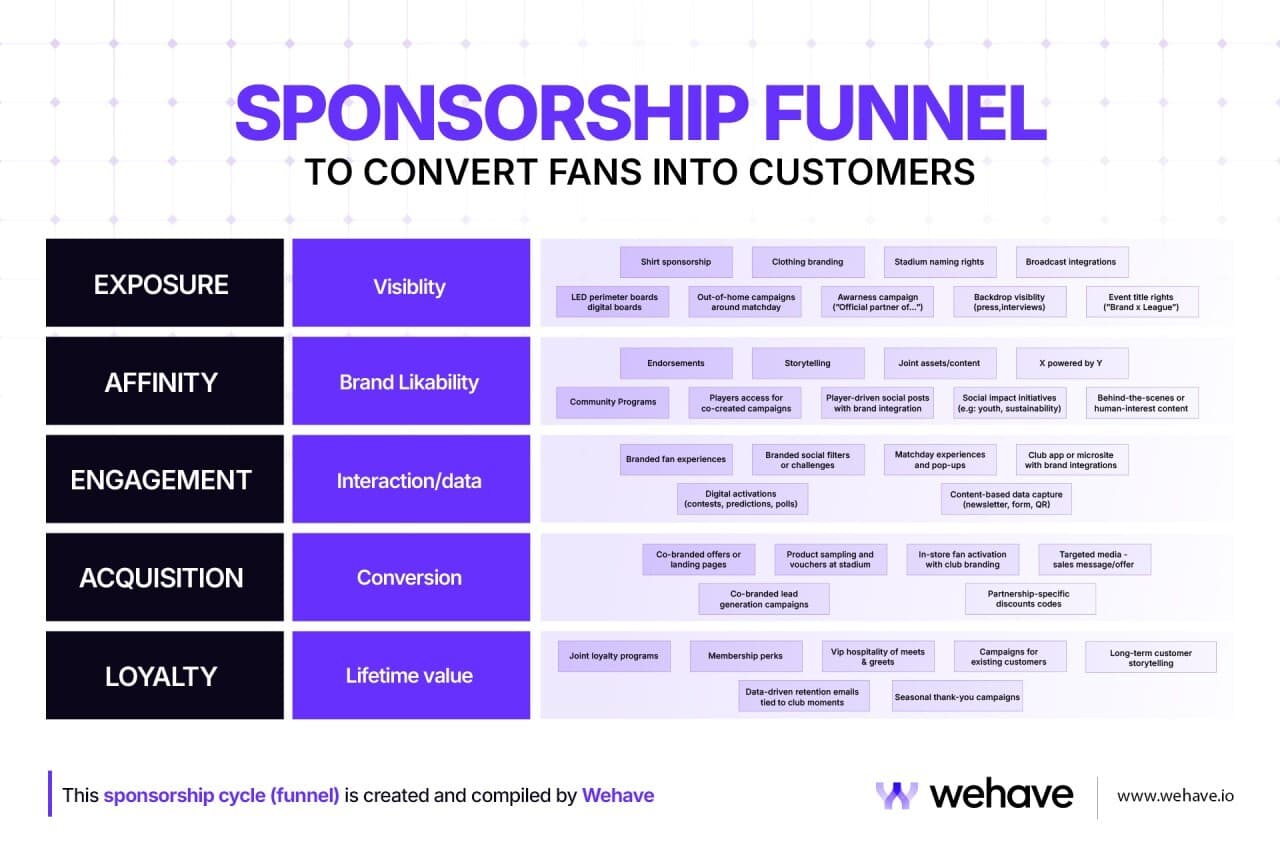
A sponsorship funnel is a structured framework that moves fans through five progressive stages: Exposure, Affinity, Engagement, Acquisition, and Loyalty. Each stage builds on the previous one, deepening the relationship between a brand and the audience it is reaching through a sports or entertainment property.
Think of it like any other marketing funnel - except the unique power of sponsorship is that it operates inside an environment of emotional intensity. Fans are already invested. They already care. The brand's job is to show up meaningfully within that world, earn trust, and eventually convert that passion into commercial action.
Most sponsorship strategies focus heavily on the top of the funnel - visibility and exposure - and then hope that ROI somehow materialises at the bottom. The sponsorship funnel closes that gap by making every stage deliberate and measurable.
This is where the sponsorship funnel begins. Exposure is the broadest stage - it is about getting the brand in front of the right audience, repeatedly and in credible contexts.
Exposure in sports and entertainment sponsorship includes shirt and clothing branding, stadium naming rights, broadcast integrations, LED perimeter boards, digital signage on matchdays, out-of-home campaigns tied to events, backdrop visibility in press interviews, and event title rights. These are the moments where millions of fans encounter a brand - often without consciously registering it.
That is not a weakness. Repeated, contextual exposure is the foundation of all brand recognition. Before a fan can like a brand, trust it, or buy from it, they need to know it exists within their world. Exposure makes that possible at scale.
“How many of the right people are seeing the brand, in the right contexts, often enough to form an impression?”
Visibility gets you noticed. Affinity gets you liked. And in the world of sponsorship, being liked by the right fans can be commercially transformative.
Affinity is built through meaningful association - endorsements, storytelling, joint content assets, and the "X powered by Y" moments that connect a brand's identity to the values of the sport or club. It is also built through community programmes, player-driven social content with genuine brand integration, social impact initiatives around themes like youth development or sustainability, and the kind of behind-the-scenes human-interest content that makes a brand feel like a real participant rather than a logo.
The brands that win at affinity understand one fundamental thing: fans are intensely loyal to the properties they love, and deeply suspicious of brands that feel like intruders. Authentic, values-aligned brand storytelling turns a sponsor into something fans actually want to see - a contributor to the world they care about.
“Are fans beginning to associate the brand with something they value and respect?”
This is the stage where sponsorship becomes a two-way relationship - and where brands can start building the data foundation that makes the rest of the funnel possible.
Engagement activations include branded fan experiences, branded social filters and challenges, matchday interactive moments and pop-ups, and club app or microsite integrations with brand touchpoints baked in. Digital activations - contests, predictions, polls - give fans a reason to interact directly with the brand. And critically, data capture mechanisms like newsletters, forms, and QR codes begin turning passive fans into known contacts.
This stage is where many sponsorship strategies leave serious value on the table. It is not enough to create an experience. The experience needs to be designed to generate data, deepen the relationship, and create a reason for the fan to come back. An engagement activation without a data capture strategy is an opportunity that disappears the moment the game ends.
“Are fans choosing to interact - and are those interactions generating actionable data?”
This is where the sponsorship funnel starts to look like the rest of marketing. Acquisition is about converting fan affinity and engagement into commercial action - leads, trials, purchases.
Acquisition tactics in sponsorship include co-branded offers and landing pages, product sampling and vouchers at stadium, in-store fan activations with club branding, targeted media campaigns with a clear sales message, co-branded lead generation campaigns, and partnership-specific discount codes that give fans a tangible reason to cross from supporter to customer.
What makes sponsorship-driven acquisition powerful is context. A fan who has seen a brand across an entire season, engaged with its matchday activations, and feels a genuine connection to the club it represents is not a cold prospect. They are a warm one - and the conversion economics reflect that. Sponsorship acquisition, done well, consistently outperforms traditional cold-audience paid media on cost per acquisition.
“Are fans being given a clear, relevant reason to take commercial action - and is that action being tracked?”
The sponsorship funnel does not end at the first sale. It ends - if it ever ends - when a fan becomes a long-term, repeat customer who genuinely associates the brand with something they love.
Loyalty is built through joint loyalty programmes, membership perks, VIP hospitality at events, campaigns specifically designed for existing customers, long-term customer storytelling, data-driven retention emails tied to club moments (a cup final, a promotion, a transfer window), and seasonal thank-you campaigns that feel personal rather than transactional.
This final stage is where the real commercial case for sponsorship is made. Customer acquisition costs in sponsorship are already competitive - but when those acquired fans stay longer, spend more, and advocate more actively than customers acquired through other channels, the lifetime value argument becomes overwhelming. Loyalty is not just the last stage of the funnel. It is the proof that the whole thing worked.
“Are acquired customers being retained, developed, and turned into advocates?”
Here is the honest reality: most sponsorships stall between Exposure and Affinity, or between Affinity and Engagement. Very few make it all the way to measurable Acquisition and Loyalty.
The reasons are almost never strategic. The strategy is usually sound. The problem is operational.
“You can't optimise a funnel you can't see. And you can't see a funnel you haven't built the infrastructure to track.”
Sponsorship teams are managing dozens of partners, hundreds of contracted deliverables, and constantly shifting activation calendars - often across contracts stored in emails, spreadsheets, and shared drives that nobody fully owns. In that environment, getting to Loyalty requires a level of execution consistency that is simply impossible without operational clarity.
Activations do not get delivered. Partners do not get called between signing and renewal. Engagement data gets captured but never used. And when renewal comes around, everyone scrambles to put together a ROI story from activities that were only half-tracked.
The solution is not a better ROI model. It is operational infrastructure that makes consistent execution possible in the first place - so the funnel can actually work the way it was designed to.
Getting the sponsorship funnel right is a combination of strategic clarity and operational discipline. Strategically, it means designing each activation with an explicit funnel stage in mind - not just asking "what will we do?" but "what stage is this for, and what does success look like here?" Operationally, it means having visibility over every commitment, every deliverable, and every touchpoint across every partner relationship.
One final point that often gets lost in the ROI conversation: the sponsorship funnel does not make ROI less important. It makes it achievable.
ROI in sponsorship is real and measurable - but only when the funnel is functioning. Without consistent execution at each stage, ROI metrics measure the output of an incomplete system. With a functioning funnel, ROI becomes a genuine signal of commercial performance: how many fans entered the top of the funnel, how many progressed through each stage, how many converted, and what did those customers generate in lifetime value?
That is a story any board, brand, or rights holder can understand - and one that builds the case for investing in sponsorship year after year.
The funnel comes first. ROI follows.
What are the 5 stages of the sponsorship funnel?
Exposure (visibility), Affinity (brand likability), Engagement (interaction and data), Acquisition (conversion to customer), and Loyalty (lifetime value). Each stage builds on the previous one and requires deliberate activation to move fans forward.
Why do most sponsorships never reach the acquisition stage?
The reasons are almost never strategic - the strategy is usually sound. The problem is operational. Sponsorship teams managing dozens of partners in spreadsheets and email chains can't maintain the execution consistency needed to move fans from engagement all the way to commercial action.
How does sponsorship ROI relate to the funnel?
ROI is only meaningful when the funnel is functioning. Without consistent execution at each stage, ROI metrics measure the output of an incomplete system. A working funnel turns ROI into a genuine signal: how many fans entered, how many converted, and what did those customers generate in lifetime value.
wehave gives commercial teams everything they need - contracts, rights, live inventory, delivery, partner portals, hospitality and AI - in one place.
Book a demoBook a demo
Forty-five minutes on the platform rather than in a deck: your competition, your partners, your seats. Nothing to fill in first, and no follow-up needed afterwards.