Oliver Wolfs
The global sports sponsorship market will reach $74.59 billion in 2026, up from $70.2 billion in 2025. That figure spans Premier League shirt deals, Formula 1 title partnerships, and naming rights megadeals. It also covers the regional insurer sponsoring a First Division club for €15,000 a year.
The mechanics are the same at every level. A club owns rights — a brand pays to access them. What happens between that handshake and renewal is where clubs retain sponsors or lose them.
This guide covers the full process — types of rights, deal structure, and what activation means in practice. It also explains why proof of delivery has become the defining commercial skill in 2026.
At its core, sports club sponsorship is a rights exchange. The club owns commercial rights — attached to its brand, venue, players, and matchdays. A sponsor pays a fee to access some of those rights in exchange for brand association with the club.
The fee is not a donation. It is a commercial transaction, and both parties expect measurable return. The sponsor gets visibility, fan association, hospitality access, and marketing rights.
The language matters. When a brand writes a cheque, they are not buying advertising. They are licensing rights — with specific obligations attached on both sides.
Not all sponsors are equal. Professional clubs structure their commercial portfolio in clear tiers. Most clubs carry between 10 and 50 active partners across these levels simultaneously.
The structure is consistent across club sizes and sports. What changes is the price attached to each tier — not the underlying logic.
The rights inventory is the commercial team's primary asset. Modern clubs operate like media companies — turning every touchpoint into potential sponsorship value. From training ground naming rights to fourth official boards, there is now a market for almost every club asset.
A sports club sponsorship deal is a legally binding commercial agreement. The key components every contract must address are:
Signing the deal is the beginning of the relationship, not the end. Activation is how sponsors bring that relationship to life. It is also where most sponsorship value gets created — or lost.
Activation takes many forms: hospitality events for client entertainment, fan-facing campaigns, co-branded content series, and data-driven outreach. Some sponsors run competitions at the ground or on the club's social channels. Others use the club's audience to reach their own customers directly.
The gap between signing and activating is where most value evaporates. Clubs that help sponsors activate — proactively, with ideas and staff time — keep partners at far higher rates. Those that deliver rights and disappear rarely see renewal.
The shift from media value to measurable outcomes is the biggest change in sports sponsorship in five years. Ten years ago, a club could renew a sponsor on brand association and a handshake. Today, that same CMO asks whether fans became customers — and whether hospitality generated real business or just goodwill.
Industry data from 2026 puts the typical sponsor expectation at 2:1 to 4:1 ROI. Every euro invested must demonstrably return two to four euros in value. That requires real data — not a PDF of social media screenshots.
Clubs that prove ROI walk into renewal from strength. Those that rebuild a PowerPoint from memory walk in hoping the sponsor liked the hospitality.
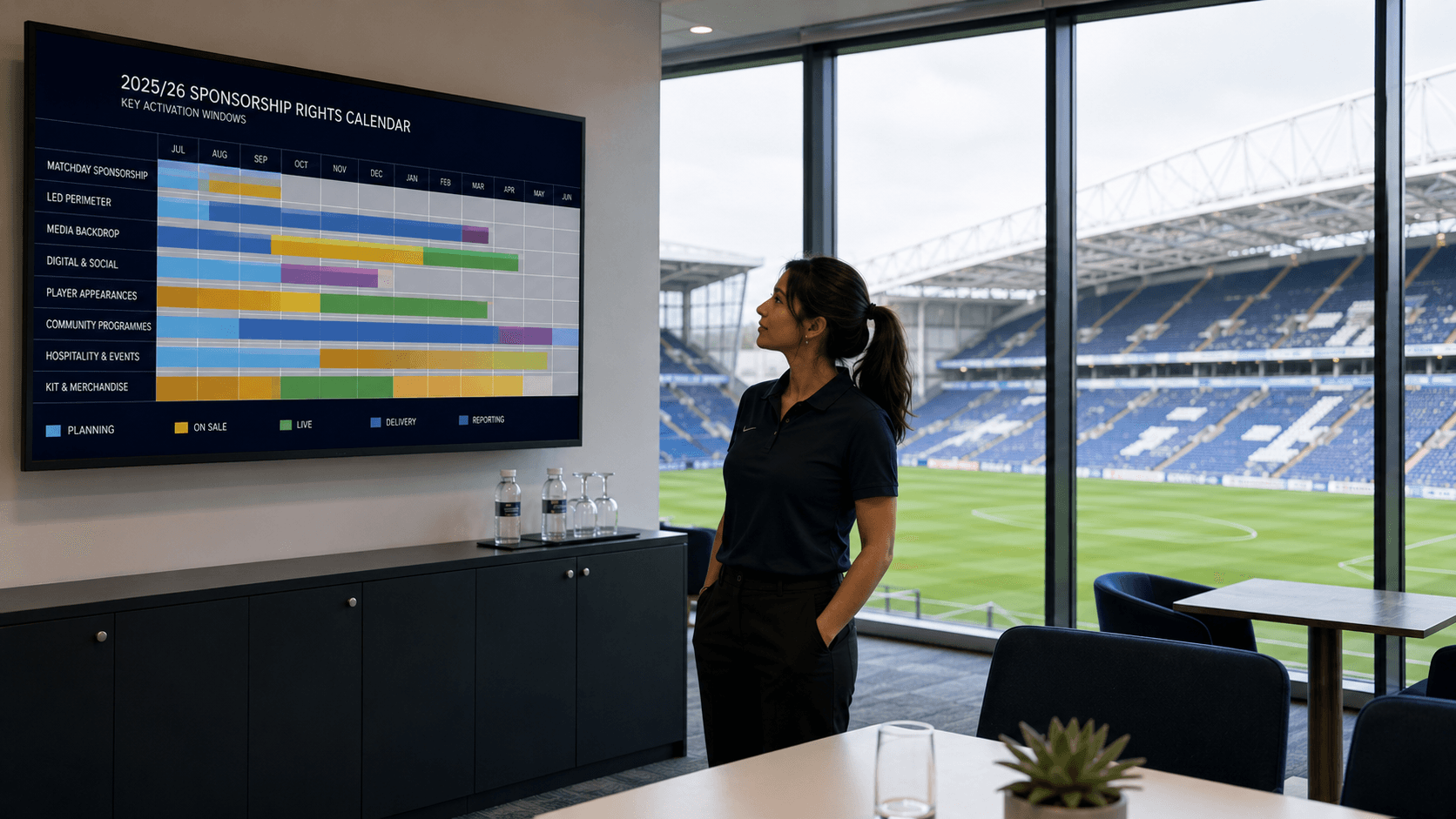
Most commercial teams manage the same operational cycle across every deal:
Most clubs handle steps one, two, and three reasonably well. Steps four, five, and six are where the process breaks down. Rights fall through the cracks, reports are rebuilt from memory, and renewal is reactive.
Several forces are reshaping how sports club sponsorship operates this year.
AI now tracks sponsor brand exposure in broadcast and social media automatically. It produces match and season reports without manual input, and flags renewals before they expire. The manual version of this work used to take weeks per partner.
Privacy-safe data matching is becoming standard for serious club-sponsor relationships. Clubs share fan data with sponsors — within strict privacy frameworks — to prove whether the partnership converted fans.
The Sunweb x Anderlecht case is the clearest example of this in practice. Sunweb matched its customer data against Anderlecht's fanbase and confirmed a strong audience overlap. The result was documented growth in customer acquisition tied directly to the sponsorship — not estimated, proven.
Brands want partnerships aligned with social values — youth development, environmental programmes, community inclusion. These deals carry non-commercial KPIs alongside standard visibility metrics.
Clubs with strong owned media channels are building digital-first sponsorship packages. Content and audience reach are growing as a share of total commercial revenue alongside traditional physical inventory.
One-season commercial deals are increasingly rare among serious partners. Brands that activate deeply over multiple seasons build audience familiarity single-season deals cannot achieve. Multi-season agreements with escalating activation commitments are becoming the standard expectation at professional clubs.
Category exclusivity is commanding a larger premium than five years ago. Sponsors have learned that association without exclusivity delivers diminished returns as competitor brands sign adjacent deals. Clubs that manage category maps tightly can charge significantly more for that exclusivity.
Sponsors in 2026 are asking for asset-level data, not aggregate campaign reports. Which specific matchday rights delivered reach? Which social posts drove clicks? Clubs that answer at the asset level renew at higher rates. They grow deal values year over year.
The commercial process looks clean on paper. At most clubs, it looks like this: rights on spreadsheets, activation over WhatsApp, reports rebuilt from memory. Renewal conversations start two weeks before the deadline — not 90 days before it.
“Found out sports clubs track €10M+ in partnerships on Excel. Started a company.”
Oliver Wolfs, co-founder of wehave
At a typical First Division club, hospitality coordination alone consumes 30+ person-weeks per season. That is €45,000+ in coordination labour per year — for a logistics job, not a commercial one. Multiply that across rights tracking, reporting, and renewal admin, and the hidden cost of the status quo becomes significant.
The problem is not effort. Most commercial teams are working hard. The problem is that the effort goes into administration — leaving less time for the relationships that drive revenue.
There is also the renewal blind spot — and it surfaces at the worst possible moment. Most clubs know what was signed: the rights categories, the term, the fee. Far fewer can account for what was actually delivered, asset by asset, across the full season.
Sponsors increasingly keep their own records of what showed up and what did not. When their account of delivery differs from the club's, renewal becomes a renegotiation before it becomes a deal. Clubs without delivery evidence enter that conversation at a real disadvantage.
Closing this gap is not about working harder. It requires systems that record proof at the point of delivery — not weeks after when the details have faded. Mid-season reports shared proactively mean renewal starts with a complete record, not a case built from memory.
The clubs winning on sponsorship in 2026 are not the ones with the most partners. They are the ones with systems — for tracking, delivering, proving, and renewing. Systems let their people focus on relationships instead of administration.
The best commercial teams understand that the deal is the starting line. Delivery, activation, reporting, and proof — that is where sponsorships are retained or lost.
The clubs growing commercial revenue in 2026 are not the ones with the most partners. They are the ones retaining what they have, building relationships systematically, and entering every renewal with evidence rather than hope. The system is what makes that possible at scale.
To see how a purpose-built platform manages this end to end, start free at wehave. No credit card, no sales call, live in under an hour.
Free to start. No credit card, no sales call, live in under an hour.
Start for free →What types of rights do sports clubs typically sell to sponsors?
Clubs sell rights across six main categories: brand association, kit placement, matchday visibility, digital and content, hospitality, and activation rights. Community and CSR co-branding has become a distinct seventh category in 2026. Most clubs package these into tiered portfolios rather than selling individual assets. A title sponsor package typically includes rights across multiple categories — not just the jersey front.
How do clubs actually value their sponsorship packages?
Valuation combines attendance and broadcast reach, fan demographic quality, category exclusivity, and comparable deals in the same league. Each input affects the price a given tier can command. Clubs also apply a cost floor: what does delivering this package cost, and what margin is required? A club should never price a package below its delivery cost.
What is the difference between a title sponsor and an official partner?
A title sponsor's name is integrated into the club's primary commercial identity. Think stadium naming rights or the front-of-shirt position. An official partner is category-exclusive but does not carry naming rights. A club may run one title sponsor and multiple official partners simultaneously across different categories. There is no conflict — each brand owns their category.
How do activation rights work in a deal?
Activation rights give the sponsor permission to run campaigns connected to the club's brand. These can run at the ground, on club channels, or in the sponsor's own marketing. Some contracts specify a minimum activation budget, separate from the rights fee. Clubs that support sponsors with ideas, data access, and dedicated staff time retain partners at significantly higher rates.
How long do sports sponsorship deals typically last?
Standard commercial partnerships run one to three seasons. Major category sponsors often negotiate three to five years. Naming rights and flagship deals typically run 10–20 years. Short deals are cheaper to acquire but costlier to manage. Renewing 15 annual contracts every season is far heavier than maintaining five three-year agreements.
What happens when a sponsor doesn't activate their contracted rights?
Unused rights leave revenue and relationship value on the table. A sponsor who doesn't activate has no evidence to justify renewal. Clubs should treat activation rate as a renewal health indicator — not just a contract compliance checkbox. When sponsors underuse their rights, the commercial team should reach out proactively. Frame it as a commercial conversation — not a compliance reminder. Ask what more the club can do to help the partner get value from the deal. Clubs that treat activation as a shared responsibility retain partners at significantly higher rates. Active sponsors renew — passive ones drift.
wehave gives commercial teams everything they need - contracts, rights, live inventory, delivery, partner portals, hospitality and AI - in one place.
Book a demoBook a demo
Forty-five minutes on the platform rather than in a deck: your competition, your partners, your seats. Nothing to fill in first, and no follow-up needed afterwards.