Oliver Wolfs
Most commercial teams learn a sponsorship is expiring from a calendar alert, three weeks out. The renewal conversation starts late, rushed, and reactive. That's damage control, not strategy.
Renewal shouldn't be an event. It should be a process running quietly in the background, one that starts months before a contract ends, not weeks. This guide covers how to build that process: the calendar, the triggers, the automation that keeps it running.
Global sports sponsorship spending hit $52 billion in 2025, per Statista — revenue renewed or lost one contract at a time. Acquiring a new sponsor costs five to 25 times more than keeping one, per Harvard Business Review's research on retention. Renewal is the highest-leverage work a commercial team does.
Picture two versions of the same club. One starts renewal conversations three weeks before each contract lapses and loses partners to whoever called first. The other starts at 90-120 days, backed by evidence, and treats renewal as routine.
Most clubs already know this. Very few actually run renewal as a system rather than a scramble every time a contract nears its end date.
Automating it is not optional.
Sponsors don't leave because of one bad match. They leave because no one showed them what they were promised, what they received and what the results were. Missing verification, unclear reporting, and no visible ROI are the top reasons partners walk, according to a sponsor retention breakdown.
None of that is a sponsorship problem. It is an operations problem. The same one Excel and WhatsApp create everywhere else in the club. Renewal automation just means giving that process the same structure your rights and reporting already have.
Most clubs find out too late that a sponsor has quietly checked out. By the time the reminder fires, if it fires at all, the sponsor has often already decided. Building the process now means every renewal starts on the club's terms, not the sponsor's.
This isn't only a CRM problem, either. A commercial director juggling 30 partnerships across a 17-game season can't hold every end date in their head. Delivery gaps and relationship signals get missed too.
The fix isn't complicated. It's the same discipline clubs already apply to rights and reporting, pointed at the calendar instead. Most of the work is deciding to start 90 days early instead of 30.
Start with a single list: every active partnership, its contract end date, and its renewal value. Pull it from wherever the information currently lives — spreadsheets, inboxes, someone's memory of "the deal that ends after pre-season."
Most clubs are surprised by what this exercise reveals. Contracts end at odd times, often clustered around the same months. They're just as often tracked in three different files that disagree with each other.
This calendar becomes your single source of truth. Every step after this one depends on it being accurate and current — not a snapshot from three months ago. A wrong or missing date here breaks every automation built on top of it.
A mid-sized club running 30 to 50 partnerships will usually find contract end dates spread unevenly across the season. Many cluster around the close of pre-season. That's exactly where a manual process breaks first — too many renewal conversations competing for the same few weeks.
A renewal calendar tells you when a contract ends. It doesn't tell you whether that partner is happy, underserved, or already gone. For that, renewal data needs to sit next to rights and delivery data — not in a separate file.
A sponsorship management platform with native rights tracking solves this by design. Every contracted right, every delivered asset, and every partner interaction lives in the same record the renewal date sits in.
This matters for partners who don't use all their social media posts, but also for hospitality-heavy partners. A sponsor whose guests haven't shown up all season is a renewal risk long before the contract expires. That gap only matters if it's visible somewhere in the system.
Most clubs treat hospitality attendance and renewal risk as unrelated, but they rarely are. A partner who stops sending guests to hospitality is usually the same partner who stops opening the season report. The signal was there weeks before the renewal date came up.
Once your calendar and your rights data live together, define when renewal work actually starts. The 90/60/30-day framework works because it keeps the conversation on your timeline, not the sponsor's.
At 90 days: internal review — delivery status, relationship health, renewal value target. At 60 days: first outreach, evidence in hand, no ask yet. At 30 days: the renewal conversation itself, backed by a season of proof.
wehave flags these three stages automatically, on every tier including Free. No one has to remember to start the clock — the clock starts itself.
| Trigger point | What happens | Who's involved |
|---|---|---|
| 90 days out | Delivery and relationship review | Account owner |
| 60 days out | First outreach, evidence attached | Account owner + partner |
| 30 days out | Renewal proposal and negotiation | Commercial director |
A single reminder at contract end catches the club off guard every time. Three staged triggers instead mean review happens while there's still time to fix a gap. The ask lands only after the case is already built.
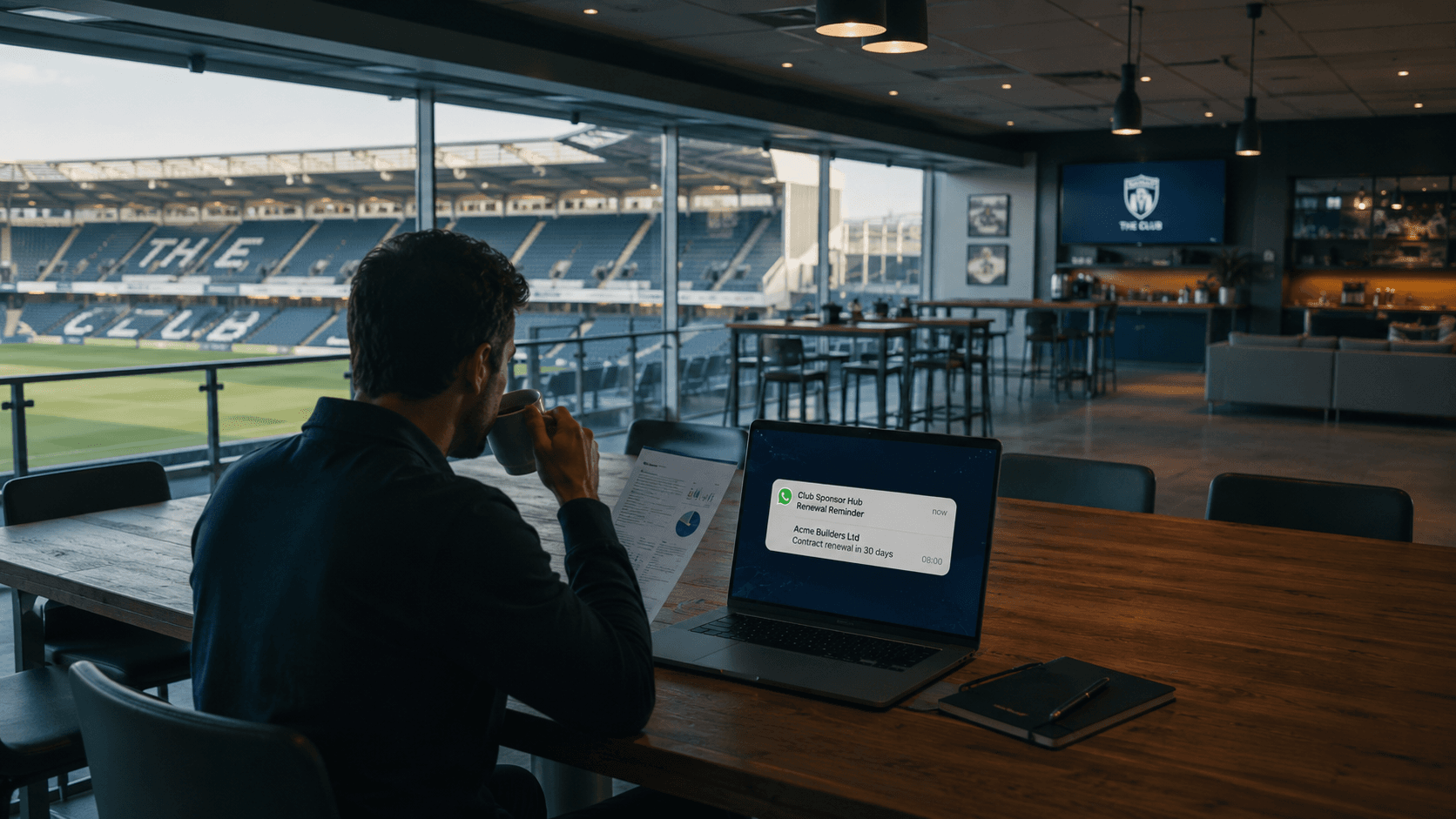
A trigger date means nothing if it lives in a system nobody checks. The reminder needs to land where the commercial team already works. It shouldn't sit buried in a spreadsheet tab no one opens between renewals.
Set the 90-day trigger to notify the account owner directly, with the partner's delivery record attached. Set the 60-day trigger to flag if outreach hasn't happened yet. Set the 30-day trigger to escalate to the commercial director if the conversation still hasn't started.
This is the difference between a calendar and a workflow. A calendar shows you a date. A workflow makes sure something actually happens on it — without anyone having to remember to check.
Get this right once and it runs every season after, for every partner, without anyone rebuilding the process from scratch.
By the time a renewal conversation starts, you should already know one thing: what the sponsor actually received. Guessing, or assembling that answer overnight, is where renewals get lost.
Proof of delivery means every contracted right is logged against what was actually delivered. That turns guesswork into a report you can hand across the table. The partner sees exactly what they received, and so do you.
A partner who raised a missed deliverable last season is a different renewal conversation than one who didn't. Both should be visible in the same record, not reconstructed from memory the week of the call.
A commercial team of three reclaims 1,000+ hours a year once automated, according to wehave's published figures. Most of those hours were previously spent rebuilding delivery evidence from scratch before every renewal call.
The strongest renewal conversations are the ones where the sponsor already knows the answer. Partner portals give sponsors a self-serve, branded view of their rights, bookings, and reports. That view updates in real time, not just at renewal time.
A sponsor who can check their delivery score mid-season isn't waiting to be convinced in week 47. They've already seen the value, game by game. Sponsors who see their value in real time renew more, and ask fewer ad-hoc questions along the way.
Every partner gets a self-serve portal in wehave. That kind of visibility does more renewal work than any single meeting can. It builds the case continuously, all season long.
The same logic applies to hospitality guests. A sponsor who can see their own confirmed table count before matchday trusts the operation behind it. That trust travels straight into the renewal conversation.
Tracking and reminders solve half the problem. The other half is the manual work of drafting the renewal — the deal record, the contract update, the follow-up.
Coach Vic, wehave's AI commercial co-pilot, reads the expiring contract and creates the renewal deal automatically. It flags the deal to the right person, including via WhatsApp. Once the new terms are agreed, invoicing is connected to what was actually delivered, not what was assumed.
Clubs using this end-to-end flow report saving roughly €15,000 a year in replaced tools, per wehave's own published figures. That's on top of the time no longer spent chasing dates manually. The renewal conversation still needs a human — the admin around it no longer does.
A redrafted contract and a new set of trigger dates used to mean starting a fresh spreadsheet row. Now the old record updates in place, with the full delivery and reporting history still attached underneath it.
Commercial teams at clubs manage dozens of partnerships each season. Renewal dates don't wait for a quiet week to review them. Automated triggers mean no renewal depends on someone remembering a date three months out.
The pattern holds regardless of club size. A First Division team of three or four people can run the same 90/60/30 discipline as a much larger club. The workflow runs itself once it's set up.
None of this requires more headcount. It requires the renewal process to stop living in someone's head and start living in a system that doesn't forget.
Across the clubs already running this system, the common thread isn't size or budget. It's simply that renewal stopped being something one person had to remember.
The gap isn't ambition. These tools weren't built for sponsorship CRM, and it shows the moment a renewal conversation needs real evidence behind it. wehave is the only one on this list actually built for that job.
Setup for the underlying system takes under an hour — no consultants, no six-month project, no dedicated IT resource. The 90/60/30 triggers can be running on every active partnership before the end of the week.
The payback shows up fast. A club that starts 90 days early, backed by evidence, typically closes before the sponsor even opens a competing conversation. One saved renewal, on a mid-sized partnership, covers a year of the platform several times over.
The bigger return compounds over a full season. Every hour not spent rebuilding a delivery report from scratch is an hour spent on the next conversation instead. That's the one that grows the relationship, not just renews it at the same value.
Clubs that run renewals well aren't the ones with the biggest commercial teams. They're the ones where the process doesn't depend on any one person remembering a date.
Most clubs don't need a bigger commercial team to hit this standard. They need the process to run on its own, the same way rights tracking and reporting already do.
Start with the calendar. Add the rights and delivery data next to it. Set the 90/60/30 triggers, and let the evidence build itself across the season — not the night before the call.
None of this requires a six-month rollout. Setup takes under an hour. The first renewal it saves from a rushed, evidence-free scramble usually pays for the switch. Start with wehave, free — no credit card, no sales call, no implementation required.
Free to start. No credit card, no sales call, no implementation required.
Start for free →How early should renewal automation start for each contract?
At least 90 days before the contract ends, not 30. The 90-day mark is when internal review and evidence-gathering should begin, well before the sponsor hears anything about it. Sixty and thirty days are for outreach and the ask, not for starting from zero.
Does renewal automation replace the actual renewal conversation?
No. It replaces the manual admin around that conversation: tracking dates, assembling evidence, drafting the deal. The conversation itself still needs a person on the call.
What's the difference between a renewal reminder and a renewal workflow?
A reminder tells someone a date is coming. A workflow triggers a sequence of actions — review, outreach, evidence, escalation — automatically at each stage. The workflow is what actually gets the renewal done.
Can a small commercial team run renewal automation without extra headcount?
Yes — that's the point. A team of two or three can run the same 90/60/30 discipline as a much larger club. That's true once the triggers are automated rather than manually tracked.
Do partner portals actually influence whether a sponsor renews?
They do, indirectly. A sponsor who can see delivery data in real time enters the renewal conversation already convinced. They don't need to be persuaded from a standing start — the case has already been building all season.
What happens if a renewal is missed because a reminder never fired?
That's usually a data problem, not an automation problem. The contract end date was wrong, missing, or living in a system the workflow never checked. A single source of truth prevents it.
wehave gives commercial teams everything they need - contracts, rights, live inventory, delivery, partner portals, hospitality and AI - in one place.
Book a demoBook a demo
Forty-five minutes on the platform rather than in a deck: your competition, your partners, your seats. Nothing to fill in first, and no follow-up needed afterwards.